TheYardWise Assessment
- Suitability: ★★★★★ Excellent — all core conditions met
- + Approx. 183-day growing season supports this crop.
- − No major climate blockers detected for this zone.
- Confidence: Medium
This guide uses city-level climate data. Your actual sunlight exposure, soil condition, and garden layout are not included. A personalized Garden Report adjusts these factors.
- Best Timing: Early in the season, before sustained heat sets in
- Main Advantage: Anchored to USDA Zone 8b for accurate timing.
- Key Advice: Follow the zone-specific planting window in this guide.
How this recommendation was determined
Recommendations are generated from TheYardWise’s climate, plant and planting-window data, reviewed against our published methodology.
- Recommended window: Early in the season, before sustained heat sets in
- Decision rules applied: Frost risk, Growing-degree maturity, Heat stress, Growing season
Understanding Portland's Climate for Growing Sugar snap pea
Portland's climate gives sugar snap peas a generous frost-free calendar, but the heat in the middle of it is the real boundary. The frost-free window — April 1 to October 1, 183 days — is much larger than the pea-friendly portion of it, because peas are a cool-season crop whose preferred range sits at the cooler margins of that window rather than across the whole of it.
The USDA Zone 8b designation describes winter cold, not summer comfort. It means Portland winters are mild enough that cold is not the constraint for peas here; the primary limiting factor is heat. That flips the usual cold-climate logic: the season is not closed out by frost arriving early, but compressed by warmth building up in the middle.
Growing degree days (GDD) track the heat available to drive growth — the faster heat accumulates, the quicker a crop moves through its life cycle. Portland's 3200 GDD over 183 days means warmth builds steadily through summer. A cool-season plant like sugar snap pea prefers to do its growing when daily heat is low, so the summer speed-up works against it: those GDD are only useful to a pea in the cooler portions of the season, when it can flower and fill pods without heat stress.
The frost dates April 1 and October 1 define when temperatures stay above freezing. But "above freezing" is not the same as "in pea range." The cool spring shoulder and the cool fall shoulder of that window are where peas thrive; the warm middle is where they do not. And because frost holds off until October 1, that fall shoulder is genuinely long — one generous frost-free season with two cool ends, and it is the ends, not the whole, that suit a cool-season pea.
Optimal Planting Window for Sugar snap pea in Portland
Sugar snap peas are a cool-season crop in Portland, and the whole timing question comes down to one fact: heat is the limiting factor. With about 60 days to maturity, those two months need to land in the cool part of the season — sustained heat stops pod set and turns the harvest tough and starchy. Timing, then, is less about picking a date and more about staying ahead of the thermometer.
Portland sits in USDA zone 8b, which means mild winters but doesn't pin down a planting date for you. The underlying window here is qualitative: plant early in the season, before sustained heat sets in. In practice, that means sowing as soon as the soil is workable — not frozen, not sopping wet — while nights are still cool. Day length helps in early spring: days are lengthening, which drives vigorous growth, even while temperatures lag behind. Don't wait for warm soil; by the time the ground feels summery, the season has already turned against the peas.
The fall window is the mirror image: plant late in the season, once temperatures cool back below the heat-stress threshold. The signal to wait for is a stretch of reliably cooler nights after the summer heat breaks, with shortening days reinforcing the cooling trend — and enough mild weeks left for the 60-day countdown to finish.
Quick reference:
- Spring: sow early, before sustained heat arrives — as soon as the soil is workable and nights stay cool.
- Fall: sow as temperatures cool below the heat-stress threshold — after summer heat breaks, with enough mild weeks left to mature.
- Either way: keep the 60 days to maturity inside the cool window; if heat arrives mid-countdown, expect fewer pods and tougher peas.
Common Problems When Growing Sugar snap pea in Portland
The trouble with sugar snap peas in Portland isn’t winter cold or a harsh growing season — the city’s USDA zone 8b climate carries “no significant limitations” for them. The real recurring problems all trace back to one biology: these are cool-season plants whose primary limiting factor is heat. Once you see every failure as a heat problem, the patterns become clear.
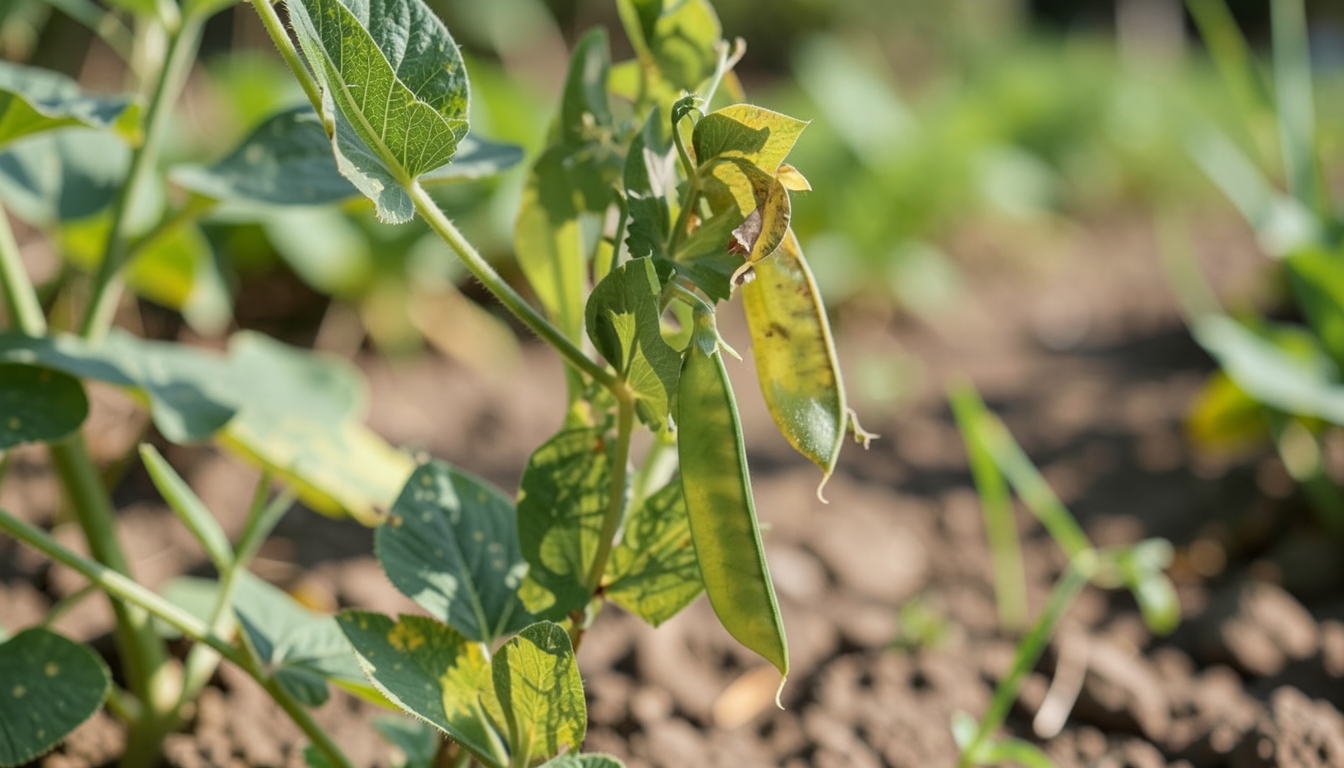
1. Heat-triggered blossom drop. The most frustrating failure is a vine that looks lush and healthy but simply stops setting pods as spring slides into warm weather. When sustained heat arrives while peas are flowering, the plant’s reproductive cycle stalls — pollen fails and blossoms drop before pods can form. Since Portland’s spring window is “early in the season, before sustained heat sets in,” the prevention is to have flowering finished before that threshold arrives. Sow at the start of the window so the plant’s most sensitive stage doesn’t collide with warming days.
2. Tough, starchy, stringy pods. Warm weather also degrades eating quality. Heat accelerates the natural conversion of sugars to starch as pods mature, so peas that sized up during a hot stretch can look perfect but taste mealy and turn fibrous. Prevention is harvest discipline: pick young, pick often, and don’t let pods fully plump — and if heat arrives while vines are still producing, treat the remaining crop as a short-term bonus, not an extended harvest.
3. Planting too late in spring. The season’s only real risk is a self-inflicted one: starting seeds so late that flowering lands in the hottest part of the year. The whole planting strategy is “heat-avoid” — the spring window closes when sustained heat sets in, and there is no recovery once it does. Prevention is treating that window as a firm deadline rather than a loose suggestion.
4. Misjudging the fall window. Fall offers a second chance, but it has two failure modes. Plant too early and seedlings meet residual summer heat; plant too late and short, cooling days slow growth to a crawl. Note that guidance on this fall window is only moderately confident. Watch the actual temperature trend — when nights are clearly cooling below the heat-stress threshold, that’s your cue to sow.
→ See how your personalized garden plan comes together — watch a quick walkthrough.
Pro Tips for Sugar snap pea Success in Portland
Keep the soil evenly moist and rich, since sugar snap peas are shallow-rooted and hate to dry out. In Portland's mild zone 8b springs, this matters because a dry spell at the wrong moment makes pods stringy and stalls new growth. Water deeply once or twice a week rather than giving the vines a daily splash, and tuck a couple of inches of compost or mulch around the base to hold moisture and keep the root zone cool — a real advantage here, where heat, not cold, is what ends the season.
Give the vines a trellis or netting and plant them in a double row. Peas climb by tendril, and letting them sprawl on the ground invites rot in damp spring soil and makes harvest a hunt. A vertical run in full sun (they'll tolerate a little afternoon shade) keeps air moving around the vines, which helps them keep setting pods right up until sustained heat arrives.
Tuck in low-growing neighbors like lettuce or radishes between or beside the rows. They're shallow-rooted and quick, so they won't compete with the peas for light or trellis space, and their leafy tops shade the soil, keeping it cool the way peas like it. Avoid tall plants that would cast shade over the vines just when they need full sun the most.
Get Your Personalized Garden Plan
The general guidance above—plant early before heat sets in, then again in fall—gives you the core timing for sugar snap peas in Portland’s Zone 8b. But every garden is unique: a sunny south-facing bed warms faster, while a wind-exposed corner stays cooler longer. These microclimate differences can shift your planting date by days or weeks. That’s where TheYardWise comes in—it uses your precise location’s climate data to build a personalized garden plan tailored to your actual conditions.