TheYardWise Assessment
- Suitability: ★★★★☆ — ★★★★☆ Good — one minor risk to manage
- + Growing season and GDD are long enough for this crop.
- + Approx. 183-day growing season supports this crop.
- − Extreme summer heat may reduce fruit set without shade or heat-tolerant varieties.
- Confidence: Medium
This guide uses city-level climate data. Your actual sunlight exposure, soil condition, and garden layout are not included. A personalized Garden Report adjusts these factors.
- Best Timing: Early in the season, before sustained heat sets in
- Main Advantage: The growing degree days in this zone are sufficient for Potato to reach maturity.
- Main Risk: Potato has low heat tolerance; this zone endures ~20+ days of extreme heat. Expect heat stress without shade or heat-tolerant varieties.
- Key Advice: Plan the main harvest before peak summer heat, or choose heat-set varieties.
How this recommendation was determined
Recommendations are generated from TheYardWise’s climate, plant and planting-window data, reviewed against our published methodology.
- Recommended window: Early in the season, before sustained heat sets in
- Decision rules applied: Frost risk, Growing-degree maturity, Heat stress, Growing season
- Key risk addressed: Potato has low heat tolerance; this zone endures ~20+ days of extreme heat. Expect heat stress without shade or heat-tolerant varieties.
Understanding Melbourne's Climate for Growing Potato
Potatoes are genuinely well suited to Melbourne — but for a reason that surprises many gardeners: the mild winter, not the warmth, does the real work. In Zone 10a it is heat, not cold, that draws the practical boundary for this crop.
USDA Zone 10a tells you that winter lows rarely dip much below freezing. For potatoes that is an opportunity: the ground does not freeze hard, so plants can keep growing through the cool months instead of being shut down by deep cold. Occasional light frost can still damage exposed foliage, but Melbourne’s mild winter effectively extends the period of cool, growth-friendly soil.
Melbourne’s 5500 growing degree days per year, by contrast, are the challenge in disguise. This generous heat budget speeds development — when temperatures are right, plants grow quickly. But potatoes are a cool-season crop whose primary limiting factor here is heat. A high GDD total means the year spends a significant share of its time above what this plant prefers, so growth must be positioned to dodge sustained warmth.
The frost-free window runs from March 22 to September 21 — a 183-day season. Crucially, frost-free and potato-ideal are not identical: this crop prefers the cooler stretches of that window rather than all of it. What makes Melbourne distinctive is that the window aligns well with the cool season, and the binding constraint at its edges is building heat, not returning frost. In short, the frost dates describe when foliage is safe; the accumulated warmth defines when potatoes will actually thrive.
Optimal Planting Window for Potato in Melbourne
Melbourne potato growing really comes down to one habit: plant to outrun the heat rather than to match the calendar. Potatoes are a cool-season crop that needs roughly 90 days to mature, and this region’s limiting factor is heat — once sustained hot weather arrives, plants slow down and stop bulking. So the whole three-month stretch needs to fit inside the cooler part of the year.
The honest answer is that there is no fixed date that works every year. The window is set by the season: a spring crop should go in early, before sustained heat builds, and a late-season crop can be planted as temperatures cool below the heat-stress threshold. In a normal year that means the cool weeks of early spring for the first planting, and autumn — once the worst of summer has genuinely broken — for the second.
Three quick checks will tell you when it’s right:
- Spring crop – plant early, in the cool stretch before sustained heat sets in. Days are lengthening, but soil is still cool and mornings carry a chill.
- Late-season crop – plant as temperatures drop below the heat-stress threshold. Nights turn noticeably cooler, days shorten, and hot weather has truly retreated — not just paused for a day or two.
- Either way, count backwards 90 days – make sure the harvest lands before sustained heat for a spring crop, or deep into cool weather for a late one.
Because Melbourne is in zone 10a, winters are mild, so frost is rarely the deciding factor — heat is. Your best cue is temperature itself: soil cool and workable, never cold, sodden, and heavy. If you wait for those signals rather than a date on the calendar, you’ll be planting when the season actually favors the crop.
Common Problems When Growing Potato in Melbourne
In Melbourne, most potato problems are heat problems in disguise. Potatoes are a cool-season crop, and in USDA zone 10a the warmth that suits them can vanish quickly as the season advances. The failures below all trace back to that tension.
Vines that collapse before the crop is made. Foliage yellows from the base upward and flops over by early summer, and harvesting reveals small, immature tubers. The cause is heat stress: as soil and air temperatures climb, the plant shifts out of tuber-building and rushes toward natural dieback, effectively shortening its own season. Prevention focuses on keeping the root zone cool — mulch heavily with straw after emergence, and hill soil around the stems so tubers form deeper, away from the warming surface.
Frost-burnt shoots. Potatoes are semi-hardy, meaning young growth tolerates a light chill but suffers real damage in a hard frost. When shoots push up during the cool part of the season, one cold overnight snap can blacken the emerged tips and stall the crop. Prevention is largely about not chasing the very first warm spell: watch the forecast, and when shoots first break soil, earth them up by drawing loose soil over them. The buried shoot resists cold damage, and the buried stem rewards you with more tubers later.
Green, sunburned tubers. Tubers exposed to light turn green and bitter — a compound called solanine. Heat makes this worse by cracking the soil surface and killing vines early, which leaves shallow tubers sitting in full sun. Prevention is generous: deep hilling at planting, a second hilling mid-season, and a straw mulch to keep both heat and light off the developing crop.
Knobby or hollow tubers from uneven moisture. Warm weather increases evaporation, and when the soil swings between wet and dry, tuber growth turns irregular — producing knobs, cracks, or hollow centres as growth restarts erratically. Prevention is consistent, deep watering plus mulch to buffer the soil from rapid drying. Potatoes grow best when the moisture around the roots stays steady, not feast-or-famine.
The particular mix of risks in your garden — which of these bites hardest, and when — depends on your soil and microclimate, which a personalized report can help weigh up.
→ See how your personalized garden plan comes together — watch a quick walkthrough.
Pro Tips for Potato Success in Melbourne
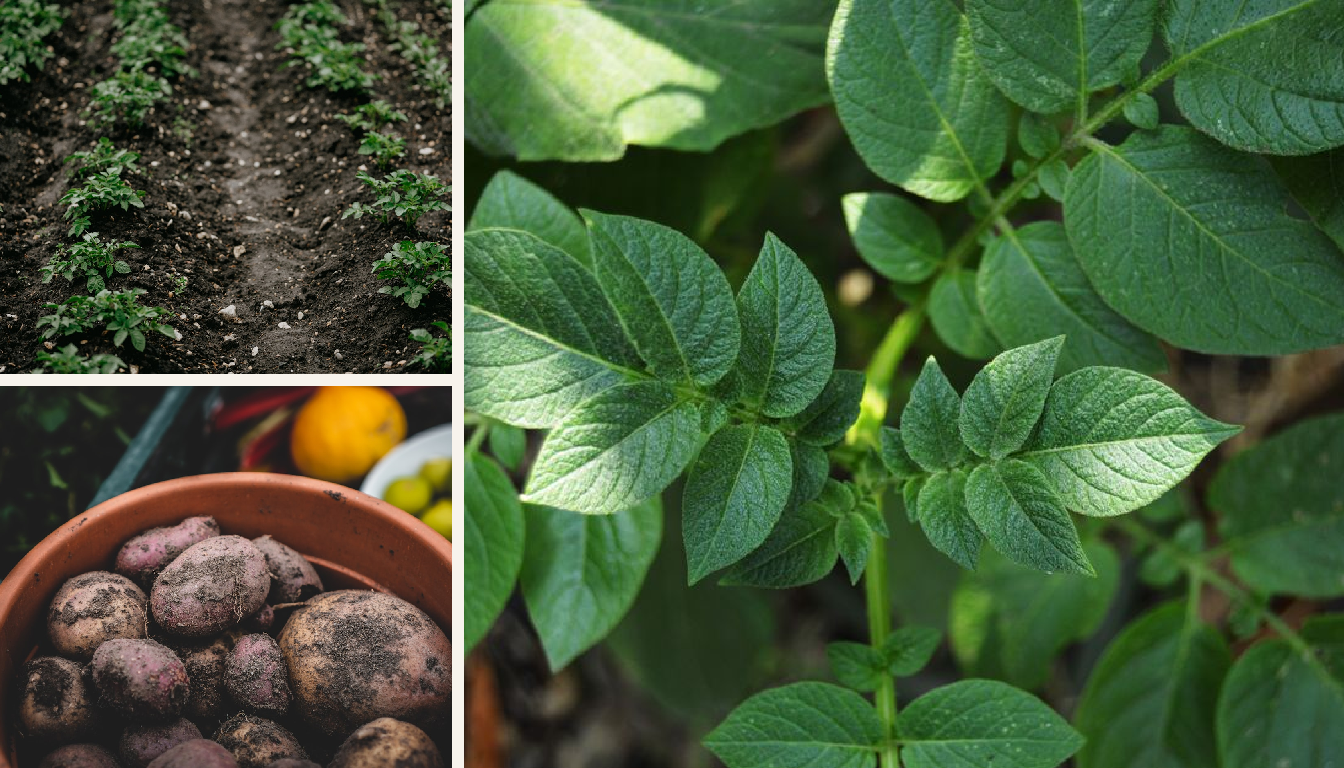
Give every seed potato a full square foot of its own — that's a real footprint, not a suggestion. Setting plants one to a square-foot cell keeps the root system and developing tubers from competing, and crowding is the quickest route to small, misshapen spuds. Since potatoes are not a vining crop, the way to add productive depth is upward: as shoots push through, mound loose soil around the stems, leaving a few leaves exposed. In a full-sun Melbourne bed this matters twice over, because tubers that work their way above ground green quickly when light hits them.
For soil and water, aim for steady moisture, never sogginess. Potatoes swell best in loose, well-drained ground, so work in organic matter before planting; compacted clay will give you knobbly tubers. Water deeply enough to reach tuber depth, then let the top few centimetres dry before the next drink — a deep soak roughly twice a week is a fair starting rhythm, adjusted by how damp the soil still feels. Ease off noticeably once the foliage yellows so skins can firm up before you lift.
Companion planting for Melbourne potatoes is not backed by settled local research, so treat it as a low-cost experiment. The traditional pairings are French or African marigolds, whose root exudates are thought to discourage soil pests, and bush beans, which fix nitrogen — just don't lean on the legumes, since overly rich soil pushes leafy growth at the expense of tubers.
Get Your Personalized Garden Plan
The timing guidance above covers the essentials for planting potatoes in Melbourne’s climate. But every garden has its own microclimates — a sunny south-facing bed warms earlier, a wind-exposed spot cools faster, and a heat-retaining corner can push your season longer. TheYardWise builds a personalized garden plan around your exact location and conditions, using local climate data to fine-tune planting windows for your specific beds. If you’d like that next level of detail, a tailored plan can help you make the most of every season.